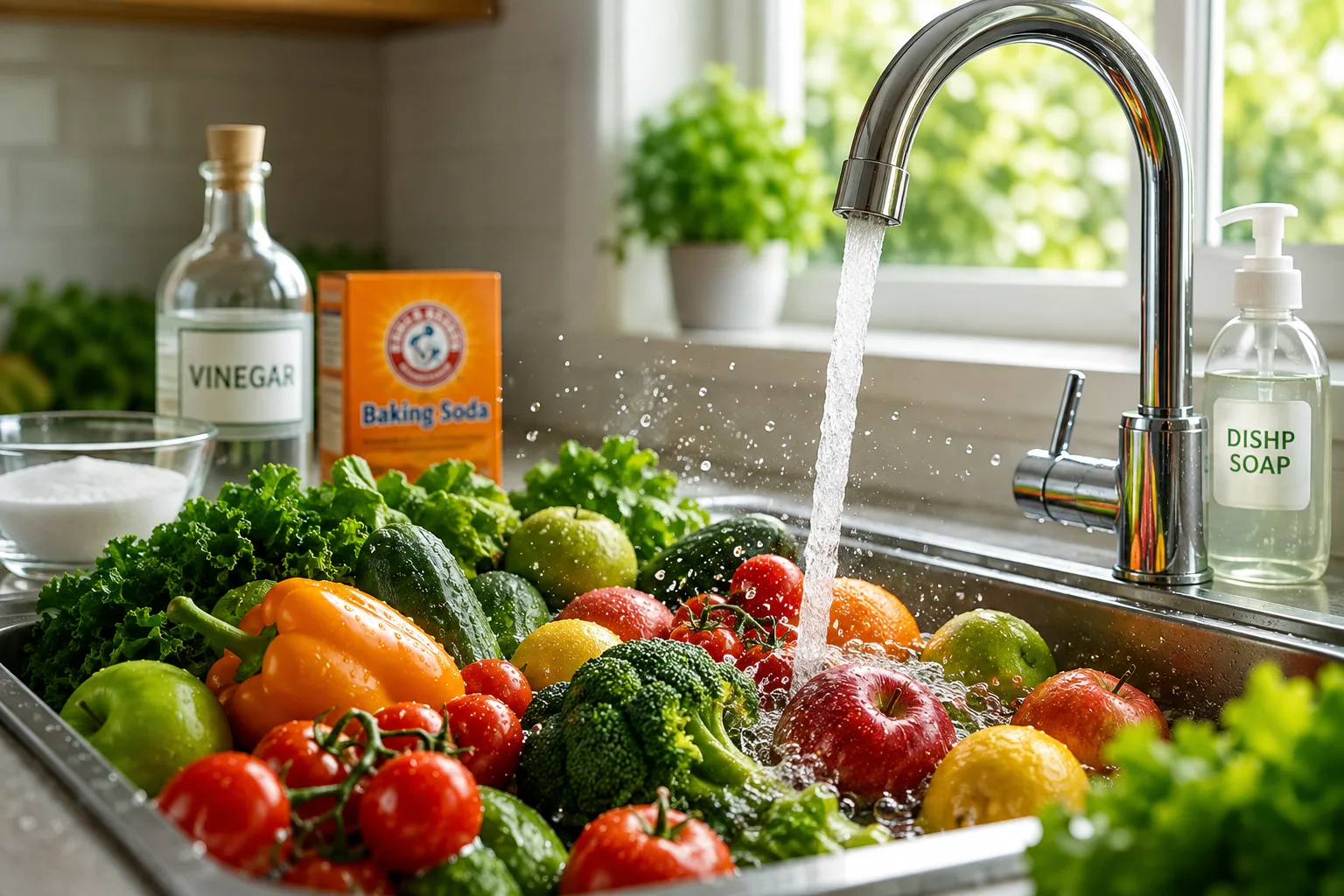
Washing fruits and vegetables at home lowers surface bacteria, pesticide residues, and soil, according to food safety agencies and nutrition researchers. Three practical methods stand out: a plain running water rinse, a vinegar soak or spray, and a baking soda soak, each backed by extension services, university studies, and federal guidance.
Why washing produce matters
Contaminated vegetables contribute to outbreaks of foodborne illness. The Centers for Disease Control and Prevention (CDC) reported 5,760 foodborne outbreaks between 2009 and 2015, resulting in 100,939 illnesses, 5,699 hospitalizations, and 145 deaths, with contaminated vegetables among the documented causes.
Pesticide residue is a concern whether produce comes from an orchard, a grocery store, or a farmers market. According to the textbook Understanding Nutrition, washing fresh fruits and vegetables removes most, if not all, of the pesticide residues on the surface. Officials note that no method eliminates every trace, but rinsing is a necessary step before eating.
What does plain running water do?
The Food and Drug Administration (FDA) and the CDC recommend plain running water as the standard method for cleaning most produce. The recommended steps are simple: place items in a colander, scrub firm produce such as apples and carrots with a vegetable brush, rinse thoroughly, and pat dry with a clean towel.
A University of California study cited in the textbook Nutrition You found that washing produce with clean running water while using a vegetable brush removed up to 81% of pesticide residue. The same study found no significant difference in residue removal between plain water and a commercial produce wash.
The FDA also advises against using detergent, soap, or commercial produce washes, because produce can absorb these products. Bagged greens labeled as pre-washed can be eaten without further washing.
How does a vinegar soak or spray help?
For small produce such as blueberries and cherry tomatoes, the University of Maine Cooperative Extension recommends soaking items in a solution of vinegar and water for several minutes before rinsing. For larger items such as bell peppers and peaches, the extension service advises spraying a vinegar-water solution on the surface before rinsing.
Vinegar can reduce bacteria on produce surfaces, though its effect on pesticide residues is more limited. Food safety specialists note that vinegar acts as a natural sanitizer and should always be followed by a water rinse.
Can a baking soda soak remove pesticides?
A 2017 study published in the Journal of Agricultural and Food Chemistry found that soaking apples in a solution of 1 teaspoon of baking soda per 2 cups of water for 12 minutes removed more pesticide residue than water alone. Study author Lili He reported that baking soda can effectively remove surface pesticide residues from produce.
The technique is straightforward. Move produce through the solution, scrub firm items, and drain before rinsing. Officials observed that soaking longer than 12 minutes is not necessary and may affect texture.
How much can washing and peeling reduce residue?
Washing and soaking reduce pesticide levels but cannot completely eliminate them. Peeling produces the largest drop. A study of field-sprayed asparagus found that washing did not change residue levels of chlorpyrifos in raw produce, but peeling reduced them by 60%. The same study reported that residues of the insecticide acephate on artichokes were completely removed by blanching and remained undetected through coring to the finished product.
Researchers note that the danger from dietary pesticide exposure depends on how potent the chemical toxin is, how concentrated it is in the food, how much and how frequently it is eaten, and the consumer’s own resistance or susceptibility. According to Wardlaw’s Contemporary Nutrition, accumulating information links pesticide use to increased cancer rates in farm communities, with higher-than-average pesticide use in rural U.S. counties tied to increased rates of lymph, genital, brain, and digestive tract cancers.
Fresh produce, whether organic or conventionally grown, remains one of the healthiest food choices available. For the cleanest food possible, growing produce at home or purchasing certified organic products are the strongest options.
What are the best safety practices around produce?
Food safety experts recommend washing hands before and after handling food to prevent contamination of other kitchen items. Keeping produce and raw meat separate helps prevent cross-contamination, and raw meat and poultry should stay separate in grocery bags, in the refrigerator, and during preparation. Officials also recommend selecting unbruised items and storing cut produce below 40 degrees Fahrenheit.
FAQ
What is the simplest way to clean produce at home?
Plain running water is the standard method recommended by the FDA and CDC. Place produce in a colander, scrub firm items such as apples and carrots with a brush, rinse thoroughly, and pat dry with a clean towel. A University of California study found this approach can remove up to 81% of pesticide residue.
How do you use baking soda to remove pesticides from fruit?
Soak produce in a solution of 1 teaspoon of baking soda per 2 cups of water for 12 minutes, then rinse. A 2017 study in the Journal of Agricultural and Food Chemistry found this method removed more pesticide residue than water alone, according to study author Lili He.
Is vinegar effective for washing fruits and vegetables?
Vinegar can reduce bacteria on produce surfaces but has limited effect on pesticide residues, according to extension service guidance. The University of Maine Cooperative Extension recommends soaking small produce in a vinegar-water solution for several minutes or spraying the solution on larger items before rinsing, followed by a water rinse.