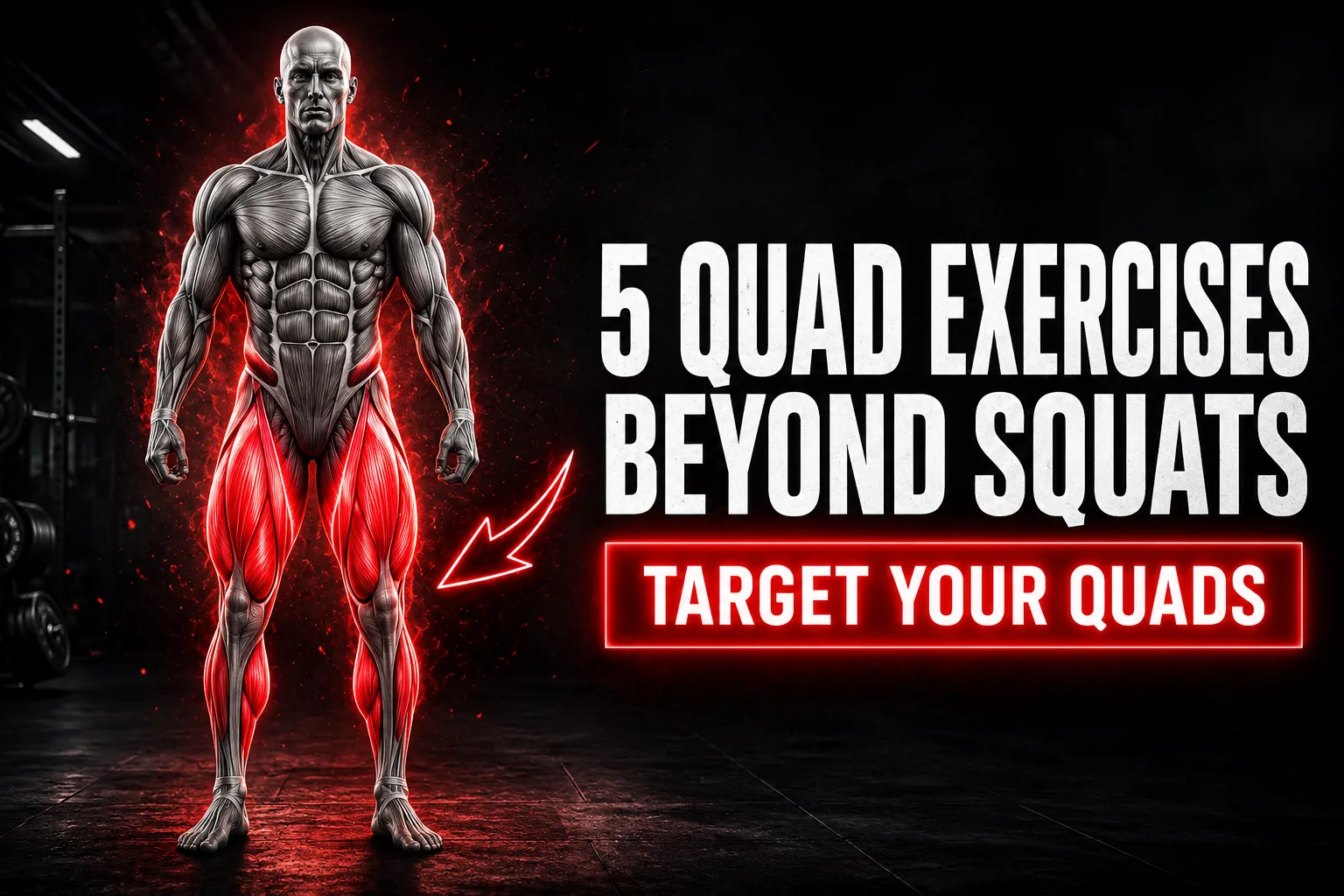
The back squat is the most popular quad exercise, but it is far from the only one. A well-rounded quadriceps routine includes movements that change joint angle, load position, and stance, so the four quad muscles (the rectus femoris, vastus lateralis, vastus medialis, and vastus intermedius) are challenged in different ways. Below are five squat alternatives worth adding to lower-body training, plus what peer-reviewed research says about resistance training volume and protein intake for muscle growth.
Why train quads with more than squats?
Variety reduces repetitive stress on the hips, knees, and lower back, and lets you bias one head of the quadriceps over another. A 2011 American College of Sports Medicine position stand, published in Medicine & Science in Sports & Exercise, recommends resistance exercise for each major muscle group on 2 to 3 days per week, with flexibility work on at least 2 days per week, as part of a balanced fitness program. Adding non-squat quad movements is one way to meet that recommendation while spreading load across multiple exercises.
What are five quad exercises beyond squats?
The five movements train the quadriceps from different angles using different equipment.
1. Leg extension
The seated or lying leg extension isolates knee extension, loading the quads through the full range of motion without much hip or lower-back demand. It is often used to bias the vastus medialis obliquus near full extension. Because the lower back is unloaded, it is a common option for people who find barbell back squats uncomfortable.
2. Bulgarian split squat
This single-leg variation places the rear foot on a bench and the front foot on the floor. The long forward stance shifts load onto the quads and glutes of the front leg while the single-leg stance challenges balance and hip stability. The movement also keeps the trunk upright, which reduces shear on the lower back compared with a heavy back squat.
3. Walking lunge
The walking lunge trains knee and hip extension together, with the quads controlling the descent of the front knee. Because each step is independent, it exposes left-right strength imbalances and forces ankle stability. It is a useful option when training space is limited.
4. Leg press
The leg press loads the quads in a seated position with a fixed path, so the lower back and grip are not taxed. Foot placement changes the stimulus: a higher and narrower foot position biases glutes and hamstrings, while a lower and wider foot position biases the quads and adductors.
5. Reverse lunge
Stepping backward instead of forward keeps the front shin more vertical and shifts more weight to the front heel, which many people find easier on the knees. The reverse lunge also loads the lead quad in an eccentric-dominant way on every step, which is helpful for athletes returning from knee injury when tolerated.
How often should you train the quads?
The ACSM position stand recommends resistance training for each major muscle group on 2 to 3 non-consecutive days per week, with at least 48 hours between sessions for the same group. Each session should include multiple exercises that target the quads from different angles, and flexibility work for the major muscle-tendon groups on at least 2 days per week.
How much protein do you need to build quad muscle?
A 2018 systematic review and meta-analysis by Morton and colleagues, published in the British Journal of Sports Medicine, pooled 49 randomized controlled trials with 1,863 participants and found that protein supplementation during resistance training increased one-repetition-maximum strength by about 2.49 kg (95% CI 0.64 to 4.33), fat-free mass by 0.30 kg (95% CI 0.09 to 0.52), muscle fibre cross-sectional area by 310 µm² (95% CI 51 to 570), and mid-femur cross-sectional area by 7.2 mm² (95% CI 0.20 to 14.30) compared with resistance training alone. The authors reported that protein supplementation beyond a total daily intake of about 1.62 g/kg of body weight did not produce further gains in fat-free mass, and that the response was smaller in older adults and larger in already resistance-trained individuals. One author, Stuart Phillips of McMaster University, disclosed grant support and honoraria from the US National Dairy Council for work on trials included in the analysis.
FAQ
Do leg extensions actually build quad size?
Leg extensions train knee extension in isolation and load the quadriceps through a full range of motion, which is one reason they are commonly used in bodybuilding and rehab settings. The 2018 meta-analysis in the British Journal of Sports Medicine found that resistance training combined with protein supplementation increased mid-femur cross-sectional area by about 7.2 mm² compared with resistance training alone, although that analysis did not isolate leg extensions as a variable.
How many times a week should I train legs?
The 2011 American College of Sports Medicine position stand recommends resistance training for each major muscle group, including the quadriceps, on 2 to 3 days per week, with flexibility work on at least 2 days per week.
Is more protein always better for muscle growth?
No. The 2018 Morton et al. meta-analysis in the British Journal of Sports Medicine reported that protein supplementation produced no further gains in fat-free mass once total daily protein intake exceeded about 1.62 g/kg of body weight in healthy adults doing resistance training.