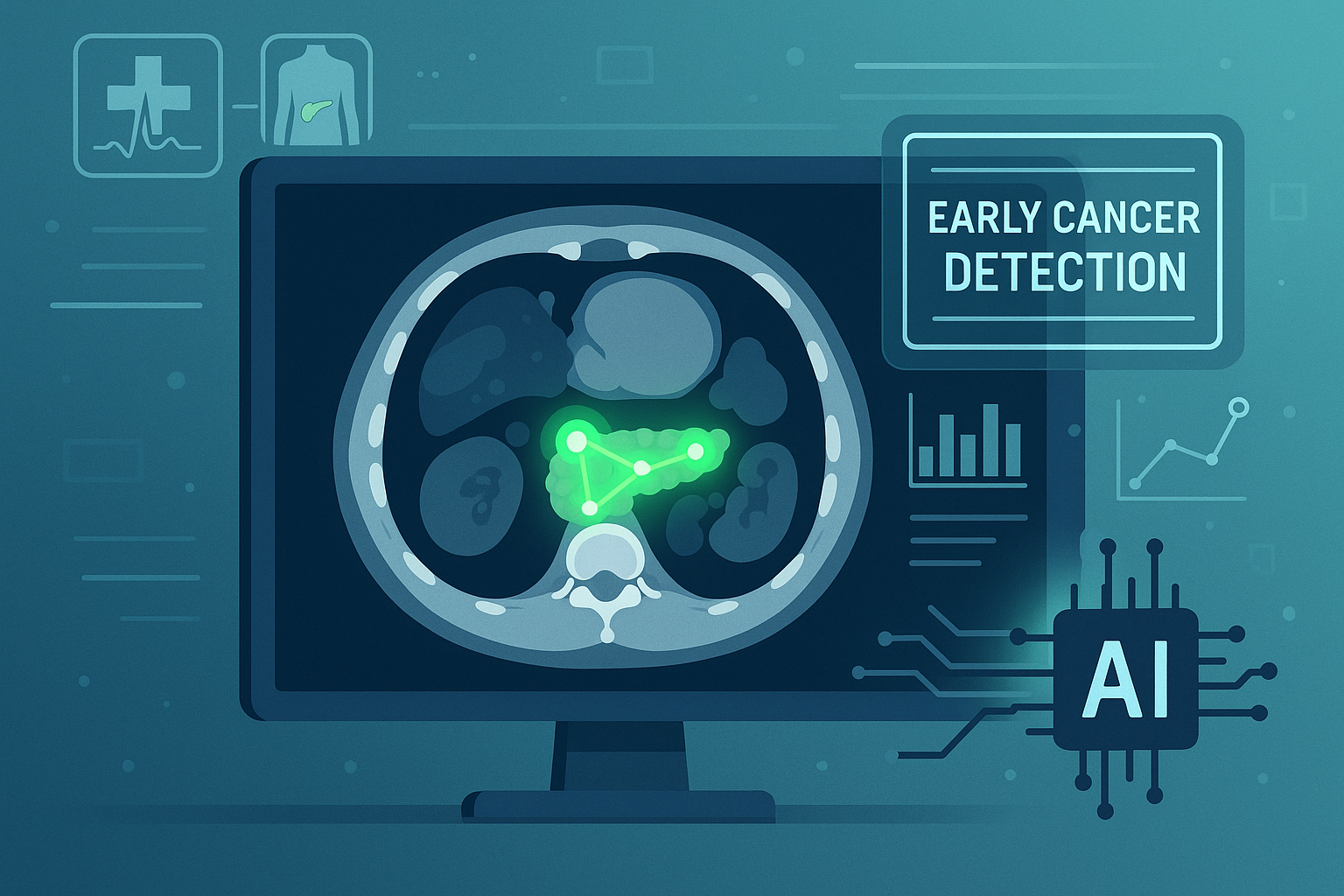
A validation study from Mayo Clinic, published April 29, 2026 in the journal Gut, found that an artificial intelligence tool called REDMOD can identify pancreatic cancer on routine abdominal CT scans up to three years before clinical diagnosis. In testing on nearly 2,000 scans, REDMOD correctly flagged 73% of pre-diagnostic cancers, nearly double the 39% rate achieved by specialists reading the same scans without AI, with a median lead time of about 16 months.
Why Pancreatic Cancer Has Been So Lethal
Pancreatic cancer hides. According to data from the National Cancer Institute cited in Mayo’s announcement:
- Over 85% of cases are diagnosed only after the cancer has already spread beyond the pancreas.
- The five-year survival rate is below 15%, among the worst of any cancer.
- By 2030, pancreatic cancer is projected to become the second leading cause of cancer-related death in the United States.
The disease produces no reliable symptoms until it has already advanced, and until now there has been no broad screening tool capable of catching it early. As Mayo’s senior author put it bluntly: “The greatest barrier to saving lives from pancreatic cancer has been our inability to see the disease when it is still curable.”
What Does REDMOD Do Differently?
REDMOD, short for Radiomics-based Early Detection Model, was developed by a team led by Ajit Goenka, M.D., a radiologist and nuclear medicine specialist at Mayo Clinic. Rather than looking for a visible tumor, the AI quantifies hundreds of subtle textural and structural features in the pancreatic tissue itself, picking up biological changes that occur before any mass forms.
Three features make the approach unusually practical:
- It runs on scans you already have. REDMOD reads routine abdominal CT scans ordered for unrelated reasons, including back pain, kidney stones, and follow-up imaging, without requiring a dedicated screening study.
- No new equipment. The model works on the imaging hardware hospitals already operate, across multiple manufacturers and protocols.
- It runs automatically. No time-intensive preprocessing or hand-segmentation by a human reader is required.
That last point matters because population-scale early detection only works if the cost per scan is near zero. REDMOD is designed to be a passive sentinel that flags the highest-risk patients, particularly those with new-onset diabetes, a known early signal for pancreatic cancer, for follow-up imaging.
What Are the Headline Numbers?
The validation study analyzed nearly 2,000 CT scans drawn from multiple institutions, multiple imaging systems, and multiple protocols, a deliberate design intended to “mirror clinical practice.” Critically, the scans included pre-diagnostic images from patients later diagnosed with pancreatic cancer. Every one of those scans had originally been read as normal by human radiologists.
- 73% of pre-diagnostic cancers were correctly identified by REDMOD.
- That detection rate was nearly double the approximately 39% detection rate specialists achieved reading the same scans without AI assistance.
- Median lead time before clinical diagnosis: about 16 months, with some cancers detected up to three years early.
- On scans taken more than two years before diagnosis, the hardest cases, REDMOD identified nearly three times as many early cancers as specialists alone.
- In patients with multiple scans over time, the model produced consistent results months apart, suggesting it may support longitudinal monitoring rather than one-off screening.
“This AI can now identify the signature of cancer from a normal-appearing pancreas, and it can do so reliably over time and across diverse clinical settings.” — Dr. Ajit Goenka, Mayo Clinic
What Comes Next: AI-PACED and Precure
The validation study is the foundation for a follow-on prospective trial Mayo is calling AI-PACED (Artificial Intelligence for Pancreatic Cancer Early Detection). AI-PACED moves REDMOD from retrospective validation into real-world clinical testing, measuring detection accuracy, false-positive rates, and downstream patient outcomes in high-risk populations.
That work fits inside Mayo Clinic’s broader Precure initiative, a program built around the idea of predicting and preventing disease by spotting earliest biological changes before symptoms appear. Funding for the work came from the National Institutes of Health, the Hoveida Family Foundation, the Mayo Clinic Comprehensive Cancer Center, and the Champions for Hope Pancreas Cancer Research Program of the Funk-Zitiello Foundation.
What Does This Breakthrough Mean for You?
An AI that flags pancreatic cancer three years early is the kind of news that changes timelines for entire families. But the technology is still in clinical validation, it is not yet rolled out across every imaging center, and you cannot request a “REDMOD scan” today. The lever you can pull right now is the same one that has always mattered most for pancreatic cancer: reduce your modifiable risk and stay ahead of metabolic dysfunction.
Studies have linked metabolic health, chronic inflammation, and pancreatic cancer risk.
- Know your personal risk profile. New-onset diabetes after age 50, a family history of pancreatic cancer, chronic pancreatitis, long-term smoking, and obesity all raise baseline risk. If two or more apply to you, that conversation belongs with your physician, not the internet.
- Stabilize blood sugar. Insulin resistance and erratic glycemic swings are cardiovascular concerns and also correlate with pancreatic stress over time. Protein-forward eating and consistent meal timing help.
- Lean anti-inflammatory. Diets rich in omega-3 fatty acids, polyphenols, and fibrous vegetables reduce systemic inflammation. Targeted supplementation with greens and quality omega-3s fills gaps that food alone often misses.
- Sleep helps regulate inflammatory load, and the body’s responses to training and stress affect it as well. Recovery support helps maintain metabolic health.
- Stay current on imaging if you are high risk. If you have a strong family history or genetic predisposition (BRCA2, Lynch syndrome, hereditary pancreatitis), ask your specialist whether MRI or endoscopic ultrasound surveillance is appropriate for you.
- Do not skip annual physicals. The reason REDMOD works is that it reads scans patients are already getting. The system can only help you if you are in it. Stay engaged with preventive care.
The Bigger Picture
For decades, pancreatic cancer has been the cancer that medicine could see only after it had already won. A model that flips that equation, even partially, is rare. REDMOD is not a cure, and it is not yet a screening program you can sign up for. But it is the first credible signal that the deadliest mainstream cancer can be caught early at scale, on equipment hospitals already own, in scans patients are already taking. That is a seismic shift, and it is worth paying attention to.
The things you control, such as metabolic health, inflammation, recovery, and completing the imaging your physician orders, remain the most useful steps you can take in the meantime.
FAQ
What is REDMOD and how does it detect pancreatic cancer early?
REDMOD (Radiomics-based Early Detection Model) is a Mayo Clinic AI that reads routine abdominal CT scans and quantifies hundreds of subtle textural and structural features in pancreatic tissue, identifying biological changes that occur before any visible tumor forms.
How much earlier can REDMOD detect pancreatic cancer compared to specialists?
REDMOD identified 73% of pre-diagnostic cancers on CT scans that had originally been read as normal by radiologists, nearly double the approximately 39% rate specialists achieved without AI. The median lead time was about 16 months, with some cancers detected up to three years before clinical diagnosis.
Can I request a REDMOD scan today?
No. REDMOD is still in clinical validation. Mayo Clinic is moving it into a prospective trial called AI-PACED to measure detection accuracy, false-positive rates, and patient outcomes in higher-risk populations before broader rollout.
Sources
- Mayo Clinic News Network — Mayo Clinic AI helps specialists detect pancreatic cancer up to 3 years before diagnosis in landmark validation study (April 29, 2026)
- Original study published in Gut (BMJ Publishing Group), April 2026
- Background statistics: National Cancer Institute