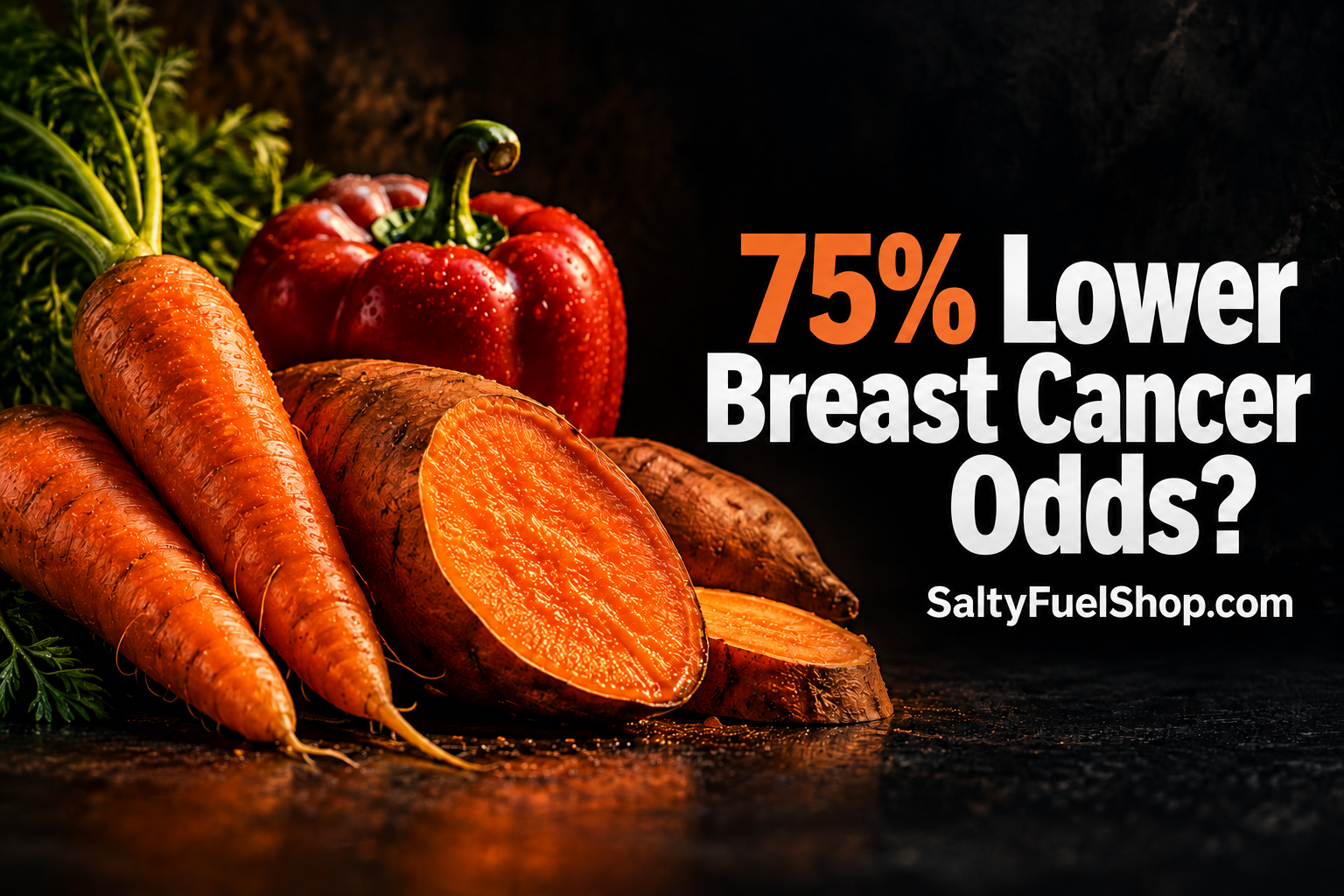
Women who ate the most carotenoid-rich foods showed up to 75% lower risk of breast cancer compared with those who ate the least, according to a peer-reviewed case-control study of 1,200 women tracked through detailed food frequency questionnaires. Carrots, sweet potatoes, and red peppers drove most of the protective effect, and the benefit scaled with intake at every step up the quartile ladder, pointing to a dose-response relationship.
What the case-control study found
Researchers compared 600 women with a recent breast cancer diagnosis against 600 healthy matched controls. Participants filled out a food frequency questionnaire that reconstructed their dietary patterns over several years. The analysis showed that the women in the highest quartile of carotenoid intake carried a substantially lower risk of breast cancer than those in the lowest quartile, with a risk reduction reaching 75% at the top of the intake range.
The protective association strengthened at each step up the consumption ladder, which researchers described as a dose-response pattern. Carrots, sweet potatoes, and red peppers were the specific foods that drove the largest share of the risk reduction. Earlier work from the University of Hong Kong had already reported that a diet rich in fruits and vegetables significantly lowers both the risk of developing breast cancer and the risk of recurrence, and a separate case-control study of breast cancer patients in Quebec linked higher carotenoid and fiber intake to fewer high-risk features on mammograms.
How carotenoids may protect the body
Carotenoids are the red, orange, and yellow pigments that give carrots, sweet potatoes, red peppers, pumpkin, tomatoes, and watermelon their color. The main dietary carotenoids include beta-carotene, alpha-carotene, lycopene, lutein, and zeaxanthin, each working through a slightly different pathway. Because carotenoids are fat-soluble, the body absorbs them more efficiently when they are eaten with a source of dietary fat such as olive oil, avocado, or nuts.
Carotenoid intake has also been linked to other health benefits beyond breast cancer:
- Cognitive function. A 2025 study of adults over 50 found that provitamin A carotenoids, which are concentrated in carrots and sweet potatoes, were associated with better cognitive performance over time. The analysis was funded by an academic grant, not an industry sponsor.
- Dementia risk. A study supported by the National Institute on Aging reported that higher blood levels of certain antioxidants correlated with a reduced risk of developing dementia.
- Eye health. The government-funded Age-Related Eye Disease Study found that substituting lutein and zeaxanthin for beta-carotene lowered the risk of advanced macular degeneration, and additional research has shown that lutein and zeaxanthin can help prevent and partially reverse certain forms of vision loss.
- Cardiovascular outcomes. A separate cohort linked higher blood lycopene levels to lower cardiovascular death risk in adults with metabolic syndrome. Lycopene, found in tomatoes and watermelon, has also shown anti-cancer activity in laboratory research.
Why whole foods, not supplements
The case-control study’s authors flagged an important distinction between food and pills. High-dose beta-carotene supplements have been shown in past trials to raise lung cancer risk among smokers, a finding that caught researchers off guard at the time. The takeaway from the report is that the protective effect comes from carotenoids delivered through whole vegetables, where they appear alongside fiber and a broader mix of plant compounds. Fiber itself has been associated with epigenetic changes that may lower cancer risk, and that broader matrix may be part of why food sources outperform isolated nutrients.
Roasting or sautéing carotenoid-rich vegetables with a healthy fat such as olive oil is a practical way to improve absorption. Rotating red, orange, and yellow produce through the week also helps cover more nutritional ground, since tomatoes and watermelon contribute lycopene while carrots and squash contribute beta-carotene.
Putting the findings into practice
Dietitians quoted in the report pointed to a simple, repeatable pattern: whole vegetables such as carrots, sweet potatoes, red peppers, and pumpkin, prepared with a source of healthy fat, eaten consistently over years. The report noted that consistency over years, not a single carotenoid-rich meal, is what drove the study results. Keeping vitamin C, vitamin D, and zinc in the routine supports related steps in immune defense and cellular repair, and zinc supplementation has been shown to improve immune response in some studies.
The public health stakes are meaningful. According to the report, nearly 23% of Americans consume vegetables and fruits less than once per day, and median vegetable intake sits at roughly 1.6 times per day. Closing that gap with colorful, carotenoid-rich produce is a straightforward step backed by the accumulated evidence.
FAQ
Which carotenoid-rich foods were linked to the lowest breast cancer risk?
Carrots, sweet potatoes, and red peppers were identified as the key drivers of the risk reduction in the case-control study, with carrots, sweet potatoes, and red peppers delivering the largest share of the protective effect.
Does eating more carotenoids actually lower breast cancer risk, or is it just correlation?
The case-control study of 1,200 women found a dose-response pattern, meaning risk dropped further with each step up the intake ladder, and the researchers concluded that higher carotenoid intake was associated with up to 75% lower risk compared with the lowest intake group.
Are carotenoid supplements as effective as eating the whole foods?
No. The report emphasized that the benefit comes from whole food sources, and high-dose beta-carotene supplements have been shown in past trials to raise lung cancer risk among smokers, making whole vegetables the preferred delivery method.