
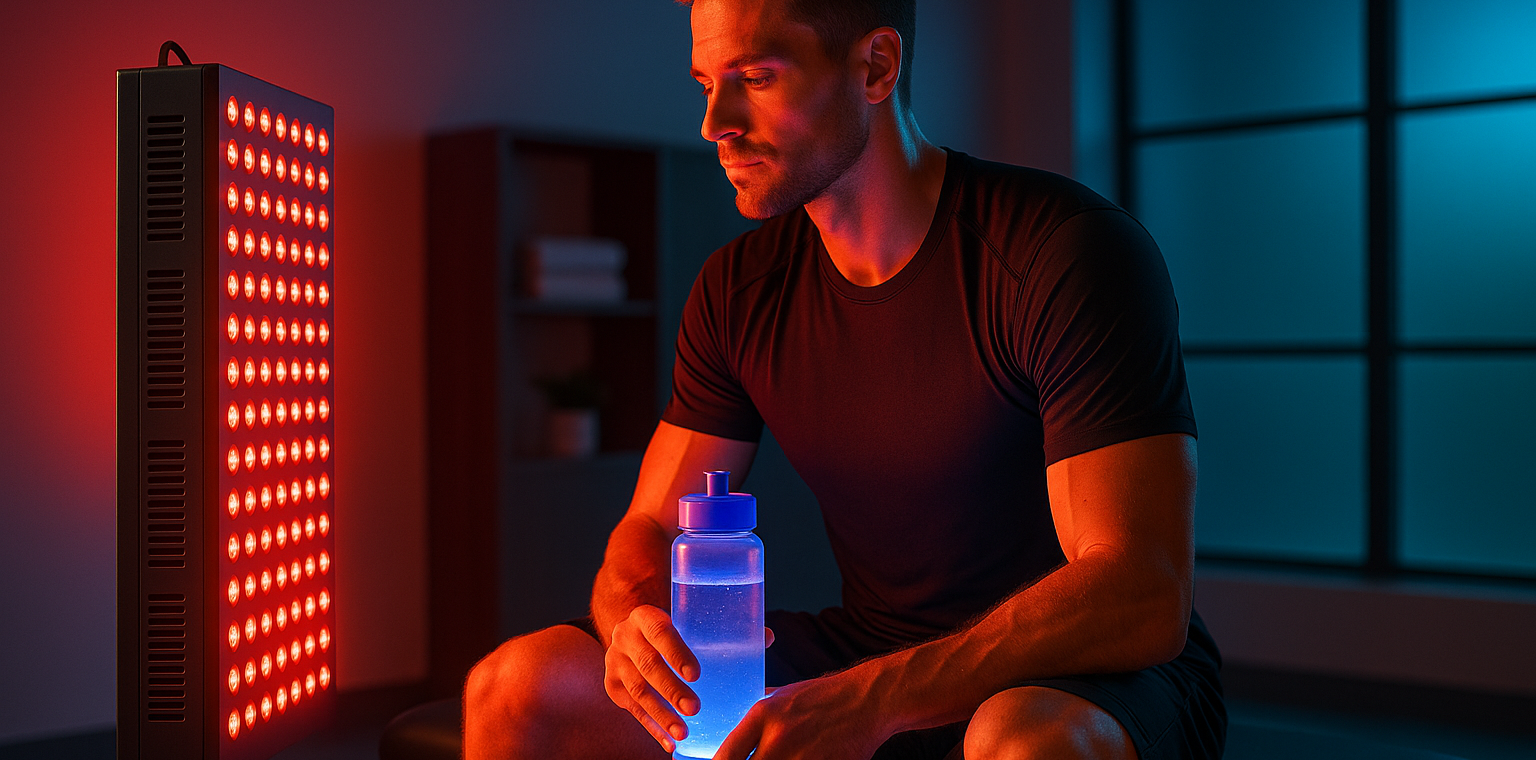
You already know hydration matters. But how you hydrate — and what’s in that water — may be more relevant to performance and recovery than most training guides acknowledge. Two areas of emerging research are worth knowing about: molecular hydrogen water and red light therapy. And there are now products that combine both.
Molecular Hydrogen Water: More Than a Wellness Buzzword
Hydrogen water — water infused with dissolved molecular hydrogen (H₂) — has over 2,000 peer-reviewed studies behind it, making it one of the better-researched areas of functional hydration. The research is still emerging and most studies are small, but the signal is consistent enough to take seriously.
The core mechanism: molecular hydrogen is the smallest molecule in existence, allowing it to cross cell membranes and the blood-brain barrier easily. Once inside cells, H₂ acts as a selective antioxidant — it neutralizes the most damaging reactive oxygen species (specifically hydroxyl radicals and peroxynitrite) without disrupting the beneficial oxidative signaling your body needs for adaptation to training.
What the Research Shows for Athletes
- Reduced exercise-induced oxidative stress — Multiple studies show reduced markers of oxidative damage after intense exercise in hydrogen water groups vs. placebo
- Decreased lactic acid accumulation — A 2012 study in the Medical Gas Research journal found hydrogen water consumption reduced blood lactate levels during exercise and improved muscle fatigue in elite cyclists
- Faster recovery between sessions — Some trials show reduced delayed-onset muscle soreness (DOMS) markers with consistent hydrogen water use
- Anti-inflammatory effects — H₂ appears to modulate inflammatory pathways relevant to overtraining and injury recovery
Important context: Most hydrogen water research involves relatively small sample sizes. This is an emerging field. The results are promising but not definitive proof of performance enhancement. We present it as science worth tracking, not a guaranteed edge.
Red Light Therapy: The Recovery Tool Going Mainstream
Photobiomodulation (PBM) — using red (630–660nm) and near-infrared (810–850nm) light to stimulate cellular energy production — has quietly accumulated one of the stronger research bodies in performance recovery. Unlike many wellness trends, PBM has been studied in clinical settings for wound healing, joint pain, and muscle recovery for decades.
The mechanism is well-established: red and near-infrared light is absorbed by cytochrome c oxidase in the mitochondria, driving increased ATP synthesis. More cellular energy means faster tissue repair, reduced inflammation, and improved muscle function.
What the Research Shows for Athletic Performance
- Pre-exercise PBM — Multiple studies show that applying red/NIR light to muscles before exercise increases strength output, endurance, and delays fatigue onset
- Post-exercise recovery — Research in strength athletes shows faster return-to-baseline strength and reduced DOMS markers with post-workout PBM treatment
- Injury recovery — PBM has FDA clearance for certain applications including pain management and wound healing, indicating regulatory recognition of clinical efficacy
- Tendon and joint health — Studies on tendons show increased collagen synthesis and reduced inflammatory markers with PBM exposure
Where Hydrogen Water and Light Therapy Converge
Some researchers propose that light — particularly infrared wavelengths — may influence the structured state of water in and around cells. Dr. Gerald Pollack’s work at the University of Washington on “EZ water” (exclusion zone water) suggests that infrared light promotes a more ordered, gel-like form of water near biological surfaces. This structured water may interact differently with cellular membranes and potentially enhance cellular hydration at a deeper level than ordinary water.
This is frontier science — interesting, credentialed researchers, real publications, but not yet mainstream consensus. The practical implication being explored: pairing high-quality hydrogen water with red light exposure may create synergistic effects on cellular energy and recovery. Consumer products have started to build on this hypothesis.
Products Worth Knowing About
Hydrogen Water Bottles
- MitoHYDRO Ultra Premium Hydrogen Water Bottle (99) by Mito Red Light — Generates 2,500–5,000 ppb dissolved hydrogen in 5–10 minutes using dual light chips (1,064nm near-infrared + 650nm red). IHSA certified, third-party tested. One of the most researched-aligned products in the space, combining hydrogen generation with light therapy principles in one bottle.
- Echo Go+ (99) — Clean, well-regarded hydrogen water bottle generating 2,000–2,500 ppb. Solid build quality, popular in the biohacking community.
- PUREPEBRIX H8000 (9) — Budget option that produces surprisingly high 8,000+ ppb output. Good entry point if you want to test the waters (literally) before committing to a premium device.
Red Light + Water Combination
- HigherDose Red Light Showerhead Filter (99) — Combines a 10-stage filtration system with dual-wavelength red and near-infrared light emitters. Post-workout shower becomes a recovery session. Reduces chlorine and heavy metals while delivering photobiomodulation to skin, scalp, and superficial tissue. Replacement filters ~20/year.
UV Purification Bottles (Sanitation Focus)
- LARQ Self-Cleaning Water Bottle — Uses UV-C light to neutralize 99.9999% of bacteria and viruses. More purification-focused than recovery-focused, but relevant for athletes training in environments with questionable water sources. Now owned by BRITA.
- Kiyo UVC Bottle by Monos (9.99) — Compact UV-C bottle with 60-second Quick Clean and 3-minute Deep Clean modes. 30-day battery life, excellent for travel and competition.
Practical Takeaways
If you’re training seriously, here’s a tiered approach to evidence-based hydration enhancement:
- Foundation first — Clean, filtered water with proper electrolyte balance. Nothing replaces this. Sodium, potassium, magnesium, and adequate volume.
- Hydrogen water for training days — The research on oxidative stress and lactate reduction is compelling enough to experiment with. A quality hydrogen bottle in the 9–99 range is a low-risk trial.
- Red light for recovery windows — Dedicate 10–20 minutes post-training to PBM exposure. Established enough science to treat as a real tool, not just a gadget.
- Structured water and light combination — Frontier territory. Interesting science, real researchers. Worth watching and experimenting with if you’re already covering bases 1–3.
Performance is built on marginals. Hydrogen water and red light therapy aren’t replacements for training, sleep, and nutrition — but the research suggests they may be legitimate tools in the recovery stack for athletes who take the details seriously.
Disclaimer: This article discusses emerging research. Products mentioned are not intended to diagnose, treat, cure, or prevent any disease. Individual results vary. Consult a sports medicine professional or physician before making significant changes to your recovery protocol.